

“We need to automate everything!”
You know how every company these days is talking about automation? But then six months later, they’re scratching their heads wondering why they’re not seeing the returns they expected.
We’ve seen this story play out dozens of times. Companies get excited about automation, different departments start their own little projects, and before you know it, you’ve got this patchwork of solutions that don’t talk to each other. It’s like having five different remote controls for your TV; technically they all work, but good luck figuring out which one does what.
This is where a well-structured Center of Excellence (CoE) becomes invaluable. And no, CoE it’s not just another fancy corporate buzzword. It’s actually the difference between automation that drives real ROI and automation that just creates expensive chaos.
In this article, we’ll dive a little bit deeper into exactly how a Center of Excellence works and its impact on corporate automation efforts.
What Exactly Is This Automation Center of Excellence Thing?
Think of it this way: remember when your company first started using email? Everybody was doing their own thing: some people used AOL, others had Yahoo, maybe a few techies were on something else entirely. Nothing integrated, sharing was a nightmare, and IT was pulling their hair out.
A Center of Excellence for automation is like having one unified email system for your entire company, but for all your automation efforts. It’s the place where strategy meets execution, where you decide what gets automated and how, and where you make sure everything actually works together.
Your CoE is a specialized team that provides structure for automation strategy, deciding what gets done as well as when and how, and helps you scale automation through all the different areas of the enterprise.
The best CoEs we’ve worked with operate like a really good project management office, but with deep technical expertise and a clear mandate to drive business results.
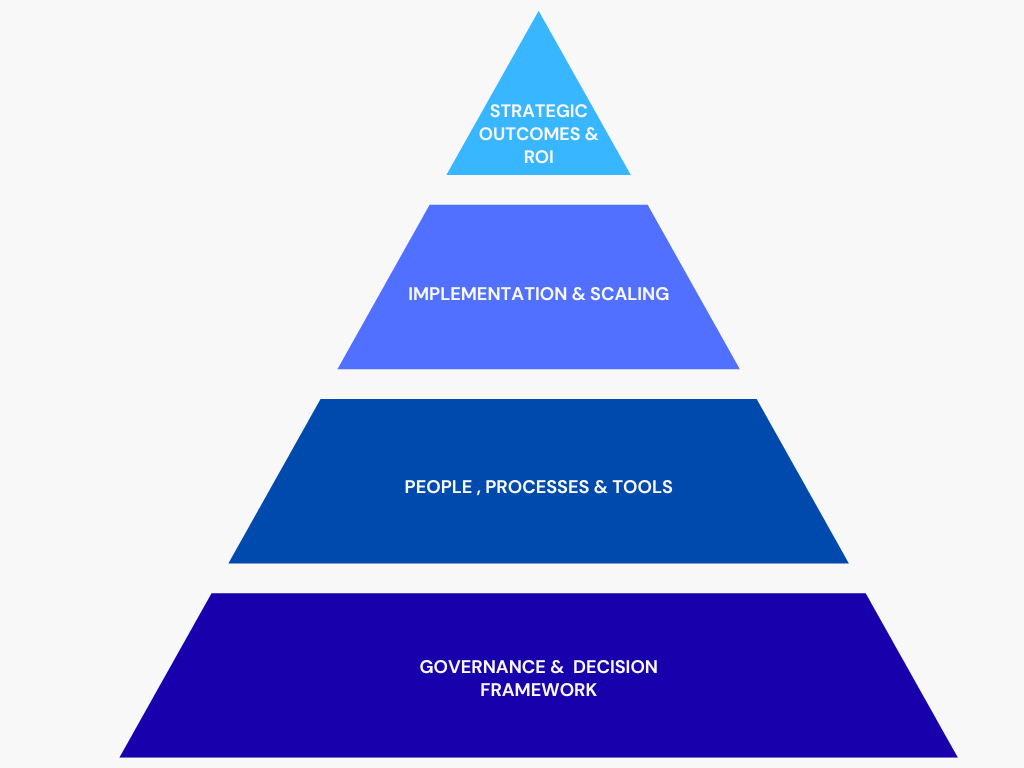
The Building Blocks That Matter
Let’s talk about a client we recently worked with. Mid-sized manufacturing company, about 2,000 employees. They came to us because they’d spent $150K on automation tools and had almost nothing to show for it. Different departments were using different platforms, nobody was talking to anybody else, and their CFO was ready to pull the plug on the whole thing.
Getting Everyone on the Same Page
The first thing we did was establish “rules of the road.” Not bureaucratic red tape, but simple guidelines about how decisions get made. When someone wants to automate a process, who do they talk to? What criteria do we use to decide if it’s worth doing? How do we measure success?
This isn’t rocket science, but you’d be amazed how many companies skip this step. They jump straight to the fun stuff, the technology, without laying the groundwork. It’s like building a house without a foundation.
Building Your Dream Team
Here’s something most people get wrong: they think a CoE is all about the tech people. Wrong. In reality, the most successful CoEs seen are like a good jazz band. You need different instruments playing together.
You need your business analysts who understand how work actually gets done (not how the org chart says it gets done). You need your tech architects who can see the big picture and design solutions that scale. And you absolutely need people from the business units who know where the bodies are buried (the real pain points that automation can solve).
At that manufacturing company, our CoE team included someone from operations, someone from finance, an IT architect, and a project manager. Five people total. Small team, big impact.
Picking Your Tools
This is where a lot of companies go off the rails. Every department thinks they need their own special automation platform.
“Our processes are different,” they say. “We need something custom.”
Look, we get it. Every department does have unique needs. But the benefits of standardization far outweigh the costs of customization. The magic lies in finding solutions that can adapt to all the moving parts within your enterprise. This keeps both costs and maintenance headaches in check.
Making the Money Work For You
Now let’s talk about the part everyone cares about: money. How do you get to the point where you are actually seeing a return on your investment?
The biggest mistake we see companies make is trying to automate everything at once. It’s like trying to eat a whole pizza in one bite: you’re going to choke.
Smart CoEs create a pipeline. They look at all the possible automation opportunities and rank them based on three things: how much impact they’ll have, how hard they’ll be to implement, and how well they align with the company’s strategic goals.
Start with the low-hanging fruit: processes that are high-volume, repetitive, and don’t require a lot of complex decision-making. Get some wins under your belt, show people what’s possible, then tackle the harder stuff.
Proving It Works
Nobody wants to wait two years to see if their automation project was worth it. The best approach is to think in terms of 90 day proof of concepts. Pick a small piece of a bigger process, automate it, measure the results, then decide whether to scale it up.
We did this with our manufacturing client’s invoice processing. Instead of trying to automate their entire accounts payable process right away, we focused on just the invoice data. 3 months later, they’d eliminated 15 hours of manual work per week and reduced data entry errors by 90%. Suddenly, everyone was a believer.
Copying Your Successes
This is where the real magic happens. Once you’ve proven that automating invoice data entry works in accounts payable, you start looking for similar processes in other departments. Purchase order processing, expense reports, supplier onboarding: suddenly you’re not just automating one process, you’re automating a pattern.
That’s how you go from saving 15 hours a week to saving 150 hours a week. It’s the multiplication effect that turns automation from a nice-to-have into a competitive advantage.
Keeping Score and Getting Better
Here’s something that separates the successful automation programs from the failures: they measure everything, and they’re constantly looking for ways to improve.
Sure, calculate your ROI. But also track things like how much faster processes run, how many errors you’ve eliminated, and how your employees feel about the changes. That last one is huge. If your people hate the automation, it’s not going to work long-term.
We set up dashboards for all our clients that show both the hard metrics (time saved, costs reduced) and the soft metrics (user satisfaction, process reliability). It gives you a complete picture of how your automation program is performing.
Never Stop Improving
The companies that get the best results from automation treat it as an ongoing journey, not a destination. They’re constantly asking questions: What else could we automate? How could we make this process even better? What new technologies should we be exploring?
That manufacturing client we mentioned? They’re now two years into their automation journey, and they’re still finding new opportunities.
The Stuff That Trips People Up
Let’s be honest, this isn’t always easy. There are some common pitfalls that can derail even well-intentioned automation programs.
Getting People on Board
The biggest challenge isn’t technical, it’s human. People are afraid automation is going to eliminate their jobs. And if you’re not careful about how you handle this, they’ll resist every step of the way.
The key is positioning automation as making people’s jobs better, not eliminating their jobs. When you automate data entry, Sarah from accounting doesn’t lose her job: she gets to spend her time on analysis and problem-solving instead of typing numbers into spreadsheets all day.
Be transparent about your intentions, involve people in the process, and celebrate the ways automation makes their work more interesting and valuable.
Dealing With Legacy Systems
Most companies have that one system that’s older than some of their employees but somehow still critical to operations. The temptation is to avoid it and hope it goes away. Bad strategy.
Sometimes you can build bridges between your automation platform and legacy systems. Sometimes you need to plan for gradual replacement. But ignoring the problem never works. Address it head-on with a realistic timeline and adequate resources.
Building Internal Expertise
You can’t outsource your way to automation success forever. At some point, you need people inside your company who understand how this stuff works and can keep it running.
Build training into your automation program from day one. Send your people to conferences, bring in experts to do workshops, and create internal certification programs. The goal is to reduce your dependence on consultants (yes, even us) and build sustainable internal capabilities.
What’s Coming Next
The automation landscape is changing fast, and successful CoEs need to be thinking about what’s around the corner.
The AI Revolution
Artificial intelligence is starting to automate things we never thought could be automated. Document review, customer service, even some types of analysis and decision-making. The companies that start building AI capabilities into their CoE framework now are going to have a huge advantage in a few years.
Don’t panic if you’re not there yet, but start thinking about it, maybe run a pilot project or two, and build relationships with AI vendors and experts.
Beyond Your Four Walls
The really exciting stuff is happening when companies start automating across their entire business ecosystem: connecting with suppliers, customers, and partners through automated processes.
Imagine your ordering system automatically talking to your supplier’s fulfillment system, which automatically updates your customer’s tracking system. That’s the future, and it’s closer than you think.
Our Advice
Look, we’ve been in this business for a while, and we’ve seen automation programs succeed and fail. The ones that succeed all have one thing in common: they take a structured, strategic approach through a well-run Center of Excellence.
It’s not just about the technology, though that matters. It’s about having the right governance, the right team, the right processes, and the right mindset. It’s about treating automation as a business capability, not just an IT project.
The companies that get this right don’t just save money, they transform how they operate. They become more agile, more efficient, and more competitive.
So here’s our advice: if you’re serious about automation, invest in building a proper Center of Excellence. Don’t try to do it on the cheap, don’t skip the foundational work, and don’t expect overnight results. But if you do it right, you’ll look back in a few years and wonder how you ever operated without it.
The question isn’t whether you need a Center of Excellence, it’s how quickly you can build one that actually drives results.