
Business Insights
Your supplier appeared on a SAT list: what the law says about the first 30 days
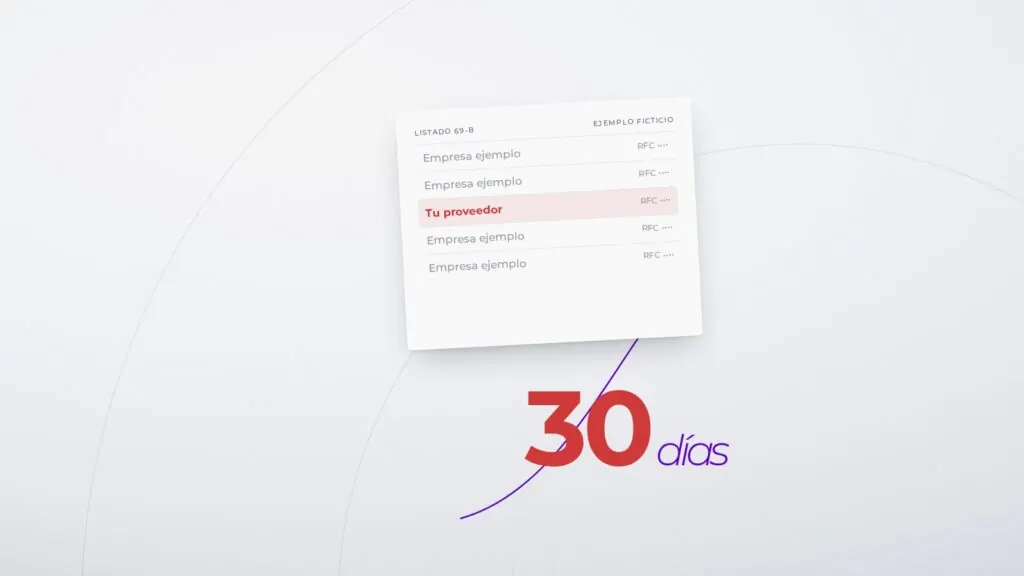
The SAT constantly publishes taxpayers who invoiced transactions they could not demonstrate. On September 22, 2026, for example, it published final 69-B list number 342, with 16 taxpayers. If one of them is your supplier, the law gives your company a deadline to act.
If one of your suppliers appeared on a list tomorrow, how long would it take your team to gather the evidence for all of its transactions?
Checklist · 16 questions · 15 minutes
If your supplier appeared on the 69-B list tomorrow, could you demonstrate your purchases in 30 days?
Try it with a real purchase and see where in the chain the evidence breaks.
Two lists, two procedures
CFF article 69-B
Suppliers without the capacity for what they invoiced
It covers those who issued invoices without having the assets, staff or capacity to provide the goods or services. Anyone who gave tax effect to their invoices has 30 days following publication of the final list to prove that they did receive the goods or services, or to correct their tax situation.
Article 49 Bis · 2026 reform
Invoices the authority determined to be false
According to PRODECON, when the issuer does not rebut the presumption, its CFDIs are considered false and its name and RFC (taxpayer ID) are published on the SAT portal and in the DOF (Federal Official Gazette). Anyone who received those invoices has 30 calendar days from publication in the DOF to reverse the tax effect with an amended return.
What happens if the deadline passes
For invoices declared false, PRODECON describes this sequence:
Recipient of CFDIs declared false
30 days
Calendar days from publication in the DOF to file the amended return
Restriction
Temporary restriction of the digital seal (CFF, art. 17-H Bis, sec. XIV)
40 days
Business days to file the clarification
No effect
The digital seal can be rendered void (CFF, art. 17-H, sec. X)
Source: PRODECON, tax implications of having received false CFDIs.
Without a digital seal, a company cannot issue invoices. That is why the impact also reaches operations and cash flow. Article 17-H Bis of the CFF provides that, once the clarification is filed, use of the seal is restored the next day. Filing it quickly depends on having the evidence at hand.
A chain effect
When the authority publishes a supplier, the problem does not stay with that supplier. Its customers have to prove their transactions or make corrections within the deadline, and if they do not, the risk of restriction passes to their own digital seal.
What to keep on hand
In both procedures, the deadline is spent rebuilding every transaction with that supplier:
- Contracts and their annexes.
- Quotes and purchase orders.
- Evidence of delivery or of the service provided.
- Who accepted the service and when.
- The invoices and their accounting entries.
- Proof of payment and its reconciliation.
If the file already exists, your tax team decides with data from day one. If it is scattered across areas and systems, a good part of the deadline goes to searching for it.
The file starts at onboarding
The first piece of materiality (materialidad, the ability to prove a transaction really took place) is built the day you onboard the supplier. From that moment, it pays to keep its opinion on compliance with tax obligations (CFF, art. 32-D), the check against the article 69-B list and the details of a bank account in its name.
Checking a supplier once is no longer enough
Many companies validate a supplier at onboarding and never review it again. Since SAT publications are constant, a supplier that was clean at onboarding can appear months later, when there are already invoices, payments and deductions involved.
How to do it without relying on manual checks
With hundreds of suppliers, checking every publication by hand becomes unworkable. Artificial intelligence can take on that work continuously:
Audit
Check that every transaction has a contract, order, delivery, invoice and payment, and that dates, amounts and descriptions match.
Monitor
Check suppliers against every new SAT publication and alert you if one appears.
Consolidate
Gather into one file per supplier and period the evidence that today sits in the ERP, the warehouse, accounts payable, the bank and email.
Generate the documentation
Have the file ready to hand over when it is requested.
That way, when a supplier appears, your tax team receives the alert and the file of its transactions at the same time, and can use the deadline to decide instead of hunting for documents.
Some decisions stay with a person. The AI escalates the case when the business purpose is doubtful, when the supplier appears on the 69-B list or when the amount exceeds the threshold your company defines. It sends nothing to the SAT and does not modify the accounting records: every response to the authority is signed by your tax team.
Frequently asked questions
What happens if my supplier appears on the 69-B list?
Anyone who gave tax effect to its invoices has 30 days following publication of the final list to prove that they did receive the goods or services, or to correct their tax situation.
What happens if I received invoices declared false under article 49 Bis?
According to PRODECON, there are 30 calendar days from publication in the DOF to file an amended return. If it is not filed, the digital seal can be temporarily restricted, with 40 business days to file the clarification.
How often should suppliers be checked against SAT lists?
With every SAT publication. A supplier that was clean at onboarding can appear months later, when there are already invoices, payments and deductions involved.
If you want to review what evidence supports each purchase, read Materiality 2026: how to have the evidence for every purchase ready.
Materiality 2026
How do you review your suppliers today?
Let’s talk about how it is done at your company.
Let’s review your processTake the checklist
Sources: Federal Tax Code (CFF), articles 17-H, 17-H Bis, 32-D, 49 Bis and 69-B; PRODECON; SAT, final 69-B list number 342 (official letter 500-05-00-00-00-2026-30410). This article is informational; Beecker does not provide tax advice.