
Business Insights
Materiality 2026: how to have the evidence for every purchase ready, from order to payment
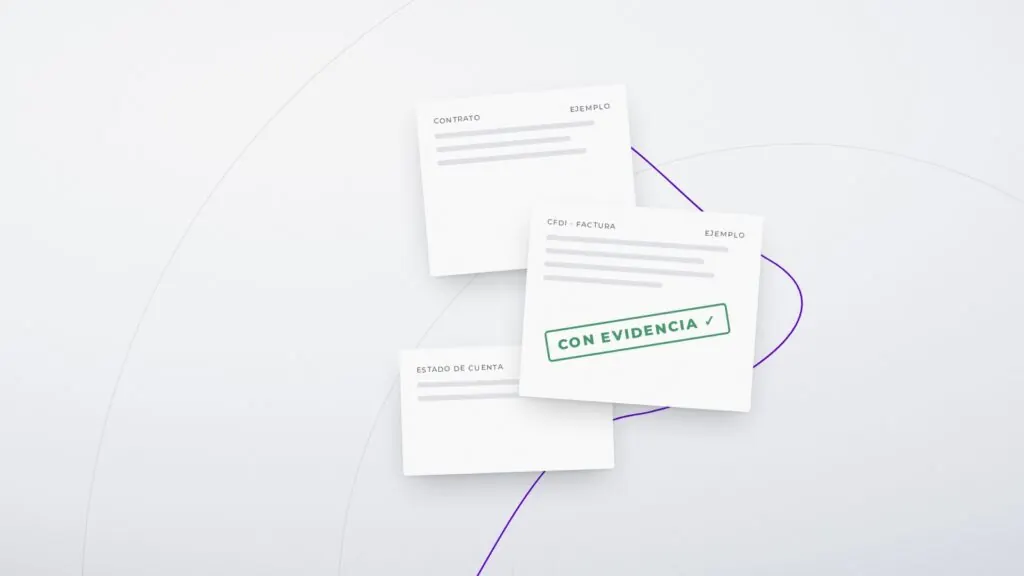
For years, having the invoice in order seemed like enough to deduct an expense. Under the 2026 reform to the Federal Tax Code (CFF), invoices that do not cover existing operations, real transactions or genuine legal acts are now considered false. Under the same reform, issuing, trading or giving tax effect to false invoices is punishable by two to nine years in prison, with mandatory pretrial detention (CFF, art. 113 Bis).
Your invoice is fine. Can you prove the materiality (materialidad) of the purchase to the SAT?
Checklist · 16 questions · 15 minutes
Could you prove a purchase from last month to the SAT?
Try it with a real purchase and see where in the chain the evidence breaks.
What is at stake
When a transaction cannot be demonstrated, the cost goes beyond the invoice:
CFF, arts. 76 and 29-A
Fine of 55% to 75%
On the omitted taxes, on top of losing the deduction and the creditable VAT on that transaction.
LIVA, art. 5 · CFF, art. 22
VAT and refunds
VAT is only creditable if the expense is deductible and the tax appears on the invoice. And every information request pauses the 40-day period the SAT has to issue a refund.
One way to size it up: how much is your company’s monthly VAT refund?
The clocks of an audit
In a standard audit, article 53 of the CFF sets these deadlines during a visit: accounting records are delivered immediately, documents you must have on hand within 6 days, and all other requests within 15. They can be extended by 10 days when the information is hard to obtain.
The 2026 reform added another clock, which runs for the supplier. In article 49 Bis it created a visit to verify that CFDIs cover real transactions, and according to PRODECON it runs like this:
If the SAT visits your supplier · article 49 Bis · business days
Day 0
Notice of the visit
Day 5
The supplier’s deadline to submit evidence expires
Day 15
The authority issues its ruling
Day 24
Maximum length of the procedure
Sources: PRODECON; CFF, article 49 Bis (2026 reform).
Those 5 business days run for the supplier being visited, and from the moment the order is delivered, the issuance of those invoices is suspended (CFF, art. 49 Bis). If you are their customer, your clock is different and lasts 30 days:
If you are the customer · final 69-B list · 30 days
Day 0
The SAT publishes your supplier on the final 69-B list
Day 30
Your deadline to show the transaction was real expires. If you do not, you correct your tax return
Sources: CFF, article 69-B (30 days after the final listing to prove the transaction or make a correction); PRODECON on article 49 Bis (30 calendar days from publication in the DOF to file the amended return). If the correction is not made, the digital seal can be restricted (CFF, art. 17-H Bis).
Thirty days is enough to hand over evidence that is already gathered. To build it from scratch, purchase by purchase, it falls short. The SAT has also flagged it as a priority: its 2026 Master Plan includes materiality among the sensitive items it will review with uniform criteria across the country.
The chain of a purchase
An audit follows each purchase link by link. Every link has to exist and match the others.
01
Contract
✓ Must show
What is being purchased and under what conditions.
✕ Usually breaks
It does not describe what was contracted.
02
Purchase order
✓ Must show
It exists and predates both the execution and the invoice.
✕ Usually breaks
It is dated after the invoice, or was never issued.
03
Execution
✓ Must show
Proof of delivery and of who received it.
✕ Usually breaks
Nobody knows where the deliverables ended up.
04
Invoice
✓ Must show
Description, period and amount that match what was contracted.
✕ Usually breaks
It is so generic that it cannot be tied to the contract.
05
Payment
✓ Must show
It can be tied to the invoice on the bank statement.
✕ Usually breaks
There is no way to link the payment to the invoice.
Three questions behind every transaction
When reviewing a transaction, the authority looks for traceability: who carried it out, what was done and when, with support that can be verified. The supplier has to exist, have the capacity for what it invoiced and be the same entity in the contract, the invoice and the payment. The good or service has to have evidence of delivery. And the period has to match across all documents.
What to keep on hand
The Mexican Association of Public Accountants (AMCP) points out what evidence supports a purchase, by type:
Purchase of goods
Quote, purchase order, delivery and receipt records, CFDI and proof of transfer.
Contracting of services
Contract, reports, emails with deliverables and logs.
It works best when that list becomes an evidence matrix by expense type, signed off by the tax team, so everyone knows what to request before paying. For example:
Expense type
Professional services
Contract
Deliverable
Meeting minutes
Expense type
Freight
Bill of lading (carta porte)
Proof of delivery
Expense type
Maintenance
Work order
Photos
It helps to add two pieces to every transaction that are often missing: the signed contract with a certified date and the business purpose, that is, why the purchase was made. And article 30 of the CFF establishes that accounting records and their supporting documentation must be kept for five years.
How fast could you respond?
Pick a purchase from last month and measure how long your team takes to pull together its five links.
In hours
Each supplier has a file by period and anyone on the team can find it.
In days
Everything exists, but you have to request it from several areas and wait for whoever knows where it is.
In weeks
Pieces are missing and the file only starts to come together when the request arrives.
The challenge is volume
With one purchase, gathering the five links is simple. With all of the month’s purchases, things change: they have to be kept for five years and suppliers have to be checked every time the SAT publishes a new list. The evidence is almost always there, spread across purchasing, the warehouse, accounts payable, the bank and email. The risk grows when nobody has it all in one place.
Where artificial intelligence helps
AI can do the repetitive work every day and leave the evidence ready before the request arrives:
Audit
Check that every transaction has a contract, order, delivery, invoice and payment, and that dates, amounts and descriptions match.
Monitor
Check suppliers against every new SAT publication and alert you if one appears.
Consolidate
Gather into one file per supplier and period the evidence that today sits in the ERP, the warehouse, accounts payable, the bank and email.
Generate the documentation
Have the file ready to hand over when it is requested.
Some decisions stay with a person. The AI escalates the case when the business purpose is doubtful, when the supplier appears on the 69-B list or when the amount exceeds the threshold your company defines. It sends nothing to the SAT and does not modify the accounting records: every response to the authority is signed by your tax team.
Frequently asked questions
What is tax materiality?
It is being able to demonstrate with evidence that an invoiced transaction did take place: who did it, what was delivered and when. The invoice alone is no longer enough to support a deduction.
What changed with the 2026 reform to the Federal Tax Code?
It considers false any invoices that do not cover real transactions and created the article 49 Bis visit to verify this. According to PRODECON, that visit allows 5 business days to submit evidence.
How long do you have to keep the evidence for a purchase?
Five years. Article 30 of the CFF establishes this for accounting records and their supporting documentation.
If one of your suppliers has already appeared on a SAT list, here we explain what to do within the 30 days: Your supplier appeared on a SAT list: what the law says about the first 30 days.
Materiality 2026
Want to review how your company does it today?
We review with you how it is done today and where it makes sense to start.
Let’s review your processTake the checklist
Sources: Federal Tax Code (CFF), articles 22, 29-A, 30, 49 Bis, 53, 76 and 113 Bis (reform published in the DOF on November 7, 2025); VAT Law (LIVA), article 5; PRODECON; SAT, 2026 Master Plan (via INDETEC); AMCP. This article is informational; Beecker does not provide tax advice.